
KAUST research develops joint beamforming and deployment strategies for ISAC-enabled HAPS systems
About
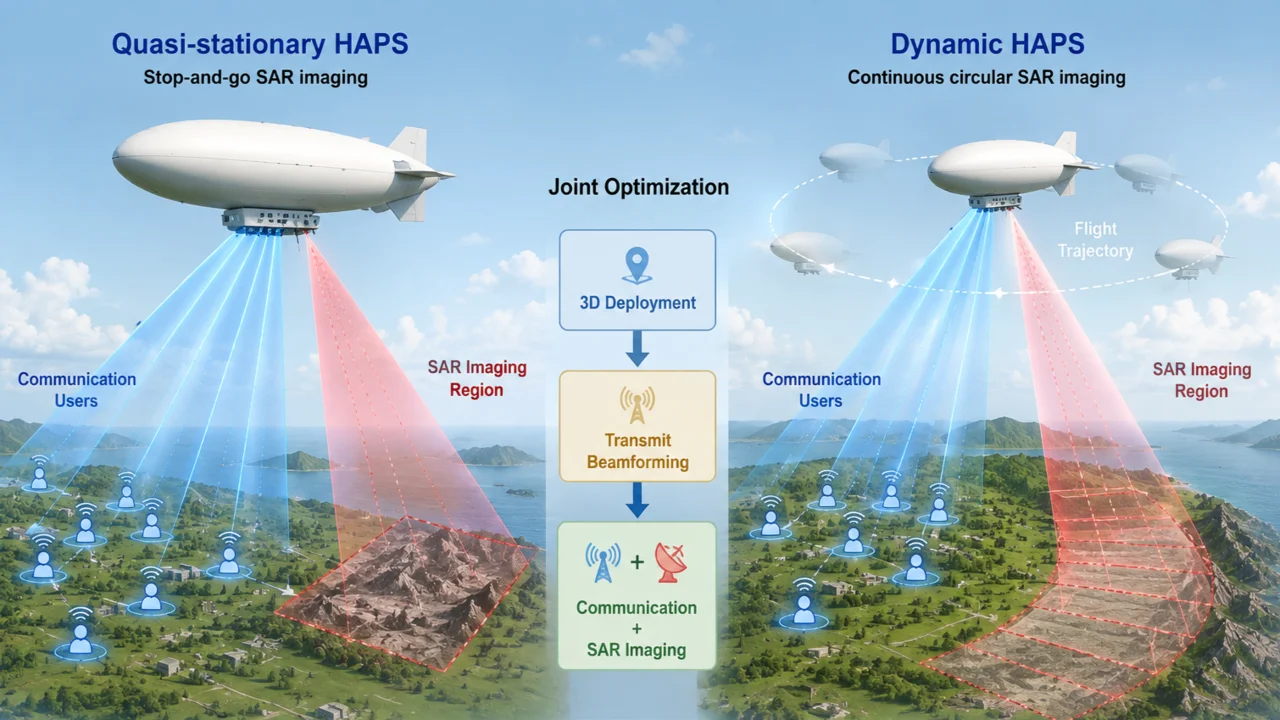
Researchers at King Abdullah University of Science and Technology (KAUST) have developed a unified design framework for integrated sensing and communication (ISAC)-enabled high-altitude platform stations (HAPS). By jointly optimizing platform deployment and beamforming, the framework enables a HAPS to simultaneously provide wireless communications and high-resolution synthetic aperture radar (SAR) imaging, offering practical design guidelines for future multifunctional aerial platforms.
The study, led by Xue Zhang, Dr. Bang Huang, and Prof. Mohamed-Slim Alouini, addresses one of the key challenges facing sixth-generation (6G) wireless systems: enabling communication and sensing to operate efficiently on the same aerial platform. HAPS, aircraft or airships operating in the stratosphere at altitudes between 20 and 50 kilometers, are increasingly viewed as a bridge between terrestrial and satellite networks because of their wide coverage and long endurance. Equipping HAPS with sensing capability would allow a single platform not only to provide wireless connectivity, but also to observe the surrounding environment using SAR, supporting applications such as environmental monitoring, disaster response, infrastructure inspection, and wide-area surveillance.
Communication and SAR imaging, however, place fundamentally different requirements on a HAPS. Communication systems aim to maximize data transmission to users, whereas SAR imaging requires carefully controlled platform deployment and beamforming to achieve high-resolution imaging. Balancing these two functions within the same platform is therefore considerably more challenging than optimizing either one alone.
To address this challenge, the KAUST team developed a unified design framework that jointly optimizes HAPS deployment and beamforming. Unlike conventional approaches that mainly focus on communication performance or adopt simplified sensing models, the proposed framework explicitly considers both communication and SAR imaging requirements within a single system design. The researchers investigated two representative deployment strategies corresponding to practical SAR operating modes.
The first strategy considers a quasi-stationary HAPS, where the platform hovers at an optimized three-dimensional location while performing stop-and-go SAR imaging. The second considers a dynamic HAPS, which continuously flies along an optimized circular trajectory while simultaneously providing communication services and performing circular SAR imaging. Together, these two deployment strategies provide practical solutions for different communication and sensing missions.
The researchers also developed efficient optimization algorithms to jointly design the platform deployment and transmit beamforming under practical communication, sensing, flight dynamics, and power constraints. Numerical results show that the proposed framework automatically balances communication and sensing objectives by positioning the HAPS between the communication users and the sensing region, rather than favoring either task alone. Compared with conventional deployment strategies, the proposed design consistently achieves higher communication throughput while maintaining the sensing quality required for SAR imaging. For the dynamic deployment strategy, jointly optimizing the flight trajectory and beamforming also provides clear performance gains over benchmark schemes with fixed trajectories.
"Future HAPS are expected to support both wireless communications and environmental sensing on a single platform. Our work demonstrates that jointly designing platform deployment and beamforming provides an effective way to balance these two functions, offering practical design guidelines for future 6G aerial networks," said Xue Zhang.
The work provides practical guidance for designing future multifunctional HAPS capable of simultaneously supporting communication and radar sensing. As HAPS continue to evolve into intelligent aerial platforms, the proposed framework could contribute to a wide range of applications, including disaster response, environmental monitoring, infrastructure inspection, and remote sensing. Future research will further investigate cooperative multi-HAPS systems, more realistic propagation environments, and broader ISAC applications.
More information can be found in the paper:
Related People

Xue Zhang
- Postdoctoral Research Fellow, Electrical and Computer Engineering

Bang Huang
- Postdoctoral Research Fellow, Electrical and Computer Engineering
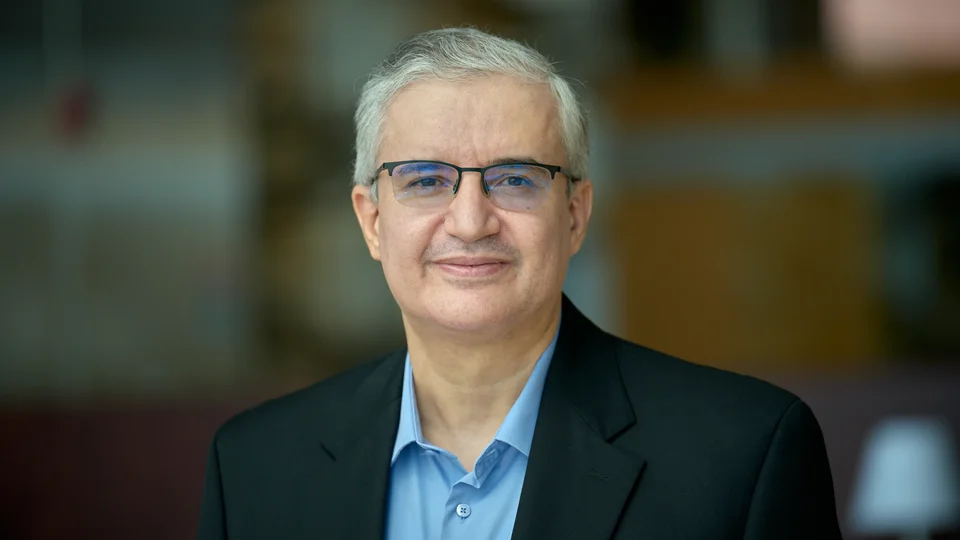
Mohamed-Slim Alouini
- Al-Khawarzmi Distinguished Professor, Electrical and Computer Engineering