
Multi-HAPS Collaboration Advances Fair and High-Capacity 6G Connectivity
About
As wireless communications continue to evolve toward sixth-generation (6G) networks, one of the greatest challenges is delivering reliable, high-speed connectivity to users. While terrestrial cellular infrastructure has significantly expanded broadband access, rural, mountainous, and disaster-affected regions still suffer from limited or unreliable coverage. At the same time, densely populated urban environments frequently experience traffic congestion that degrades network performance. Addressing these diverse connectivity demands requires new network architectures capable of extending coverage while maintaining both high capacity and fairness among users.
High-altitude platform stations (HAPSs) have emerged as a promising component of next-generation non-terrestrial networks. Operating in the stratosphere at altitudes of approximately 20 kilometers, HAPSs exhibit characteristics that are complementary to both satellite and terrestrial communication systems. Compared with satellite platforms, their lower operating altitude generally results in shorter propagation distances, reduced transmission latency, and pathloss. Compared with conventional terrestrial infrastructure, HAPS can provide wide-area coverage and support communication services in regions where the deployment of ground base stations is technically difficult or economically impractical. These characteristics make HAPS a valuable candidate for extending network coverage, enhancing service availability, and supporting digital inclusion in future 6G systems.
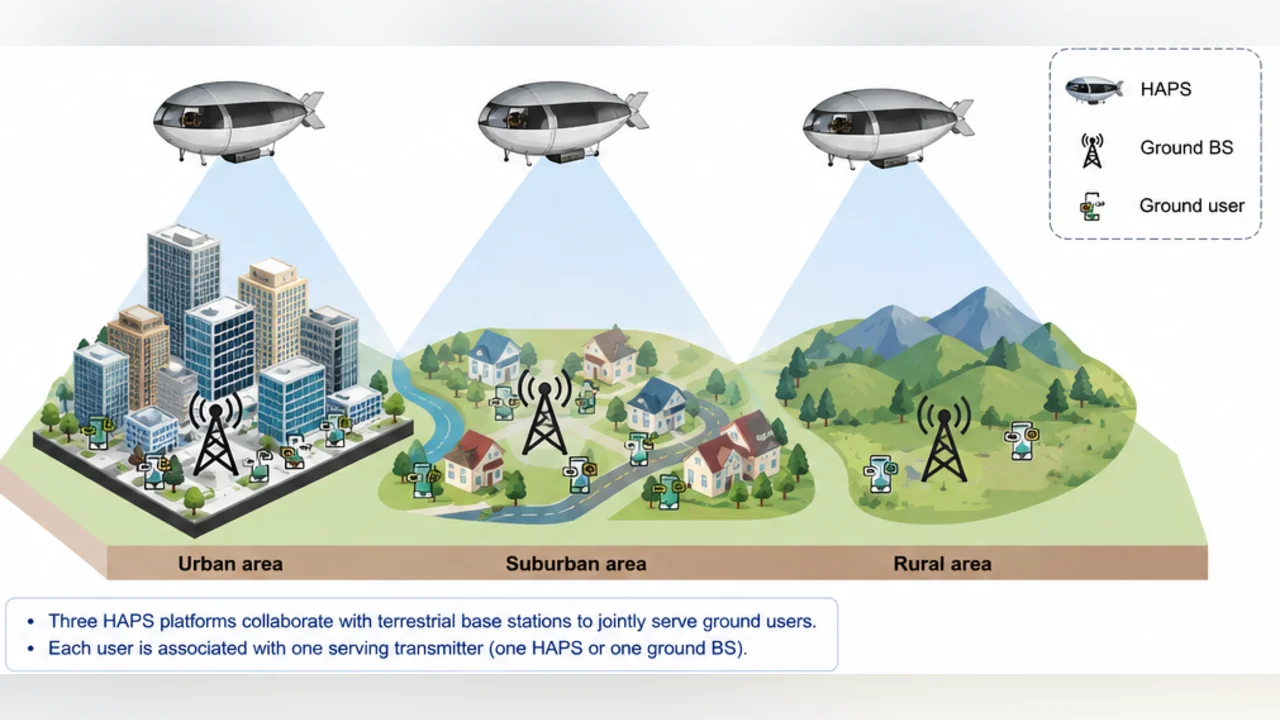
In a recent study, researchers from King Abdullah University of Science and Technology (KAUST) and the University of Sharjah propose a multi-HAPS–ground integrated network, where multiple HAPSs and terrestrial base stations jointly optimize user association and beamforming under practical payload, power, and quality-of-service constraints. This enables more efficient utilization of network resources while balancing throughput and user fairness.
The research focuses on balancing two fundamental objectives that are often difficult to achieve simultaneously. The first objective is maximizing the worst-case signal-to-interference-plus-noise ratio (SINR), ensuring that users experiencing poor channel conditions still receive reliable communication services. The second objective is maximizing the weighted network sum rate, which improves the overall throughput of the system while satisfying users' minimum quality-of-service requirements. Together, these objectives address the practical challenge of balancing network fairness with overall system efficiency, a key requirement for future heterogeneous wireless networks.
Solving these optimization problems is particularly challenging because user association and beamforming decisions are tightly coupled and subject to several practical system constraints. The proposed framework accounts for HAPS payload limitations, transmitter power budgets, and minimum user rate requirements while determining how users should be associated with either aerial platforms or ground base stations. To efficiently solve this mixed discrete-continuous optimization problem, the researchers first formulate the user association process as a generalized assignment problem. Once the serving transmitter for each user is determined, beamforming vectors are optimized using successive convex approximation (SCA), which transforms difficult non-convex optimization problems into a sequence of tractable convex subproblems. This approach achieves high-quality solutions while maintaining practical computational complexity.
An important feature of the proposed algorithms is their suitability for distributed implementation. Instead of relying on a single centralized controller to perform all computations, each HAPS and ground base station independently optimizes its own beamforming strategy while exchanging only limited interference-related information with neighboring transmitters. This distributed architecture improves scalability and makes the proposed framework better suited for future large-scale non-terrestrial networks, where multiple aerial platforms may simultaneously cooperate across extensive geographical areas.
Simulation results demonstrate the significant advantages of collaborative multi-HAPS deployment. Compared with conventional ground-only networks, the proposed framework substantially improves both the minimum achievable SINR and the overall network throughput, with the performance gains becoming more pronounced as additional HAPSs are deployed. The study further shows that incorporating directional HAPS antenna patterns enhances system performance by reducing interference and improving spatial reuse. These results highlight the effectiveness of cooperative aerial-terrestrial networking in extending broadband connectivity across urban, suburban, rural, and other underserved regions.
Overall, this work provides a practical optimization framework for integrated multi-HAPS-ground networks by jointly addressing user association and beamforming under realistic payload, power, and quality-of-service constraints. The proposed algorithms are further amenable to distributed implementation, making the framework scalable for future large-scale non-terrestrial networks. By balancing network throughput and user fairness while accounting for practical deployment considerations, this research provides valuable insights into the design of resilient, efficient, and digitally inclusive 6G wireless systems.
More information can be found in the paper:
Related People



Abla Kammoun
- Senior Research Scientist, Electrical and Computer Engineering
Mohamed-Slim Alouini
- Al-Khawarzmi Distinguished Professor, Electrical and Computer Engineering