
KAUST Research Develops Directional-Beam Analysis Framework to Guide HAPS Network Design
About
High-altitude platform stations (HAPS) can extend wireless service from the stratosphere, but planning a large deployment requires more than estimating one strong air-to-ground connection. As platform and user populations grow, designers must also account for many co-channel interferers, Earth curvature and the directions in which antennas point.
That combination makes direct network simulation increasingly demanding: the paper notes that the number of serving and interference links can grow quadratically with the number of HAPS. Zhengying Lou, Baha Eddine Youcef Belmekki and Mohamed-Slim Alouini therefore developed an analytical way to assess coverage without relying entirely on repeated large-scale simulations.
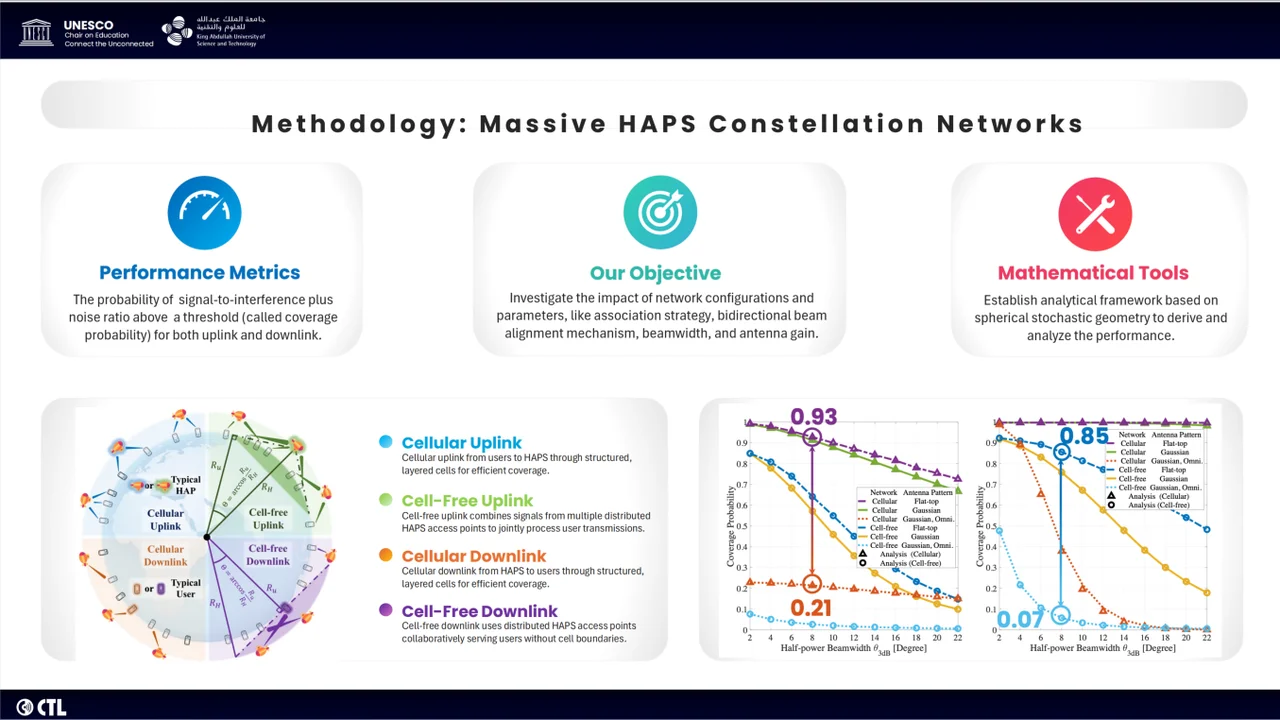
The method first treats platform and user locations as random points on two concentric spherical surfaces. This ordinary-language picture becomes a spherical stochastic-geometry model: a mathematical framework for averaging network behavior over many possible spatial layouts while naturally retaining Earth curvature and line-of-sight visibility. It also represents bidirectional directional beams. On a serving link, the user and HAPS point toward each other; on other links, their pointing directions are generally offset. Rather than restricting the analysis to an idealized flat-top beam, the channel model can accommodate several antenna patterns and their gradual gain roll-off.
Within one framework, the team derived coverage expressions for both uplink, from users to HAPS, and downlink, from HAPS to users. The analysis covers cellular association, where a user selects the HAPS providing the strongest average received power, and the paper's cell-free model, where a user associates with a HAPS in its visible line-of-sight region.
The results show clear trends. Directional reception can substantially improve coverage, and narrower half-power beamwidths generally raise coverage by concentrating useful energy and rejecting more off-direction interference. Increasing maximum antenna gain helps at first, but the improvement eventually levels off as both desired and interfering powers rise. Association distance is equally important. Under the studied assumptions, cellular networks generally outperform the cell-free case because cellular association produces shorter contact distances. Increasing HAPS density improves uplink coverage, especially in cellular networks, while cell-free downlink coverage decreases approximately linearly with HAPS density because random association does not shorten the average contact distance enough to offset added interference.
Across the reported numerical tests, analytical points matched Monte Carlo curves averaged over 10,000 iterations for the examined antenna, density and threshold settings. This agreement supports the framework as a rapid evaluation tool within its assumptions, rather than as an independently deployed network demonstration. First author Zhengying Lou said: “Our aim was to make the effects of directional beams and network geometry visible at system scale, so designers can compare coverage trade-offs before committing to a deployment.”
The framework can guide choices such as platform density, beamwidth, antenna gain and association strategy, but it evaluates candidate systems rather than inventing an optimal design. Its present analysis also simplifies multi-antenna operation. The paper's multibeam study finds only a slight downlink-coverage penalty alongside a fourfold channel-capacity increase; extending the spherical analysis to multibeam HAPS with MIMO channel matrices and antenna correlation is the identified next step.
More information can be found in the paper:
Related People

Zhengying Lou
- Ph.D. Student, Electrical and Computer Engineering

Baha Eddine Youcef Belmekki
- Postdoctoral Research Fellow, Electrical and Computer Engineering
Mohamed-Slim Alouini
- Al-Khawarzmi Distinguished Professor, Electrical and Computer Engineering