
High Altitude Platform-Based Caching and Multicasting for Rural Connectivity
About
Researchers at King Abdullah University of Science and Technology (KAUST) have developed a framework to reduce the power cost of delivering digital content across underserved rural areas. The work was conducted by Yongqiang Zhang during his doctoral research at KAUST with Prof. Mohamed-Slim Alouini and Prof. Mustafa A. Kishk of Maynooth University. Yongqiang Zhang is now a Postdoctoral Associate at New York University Abu Dhabi.
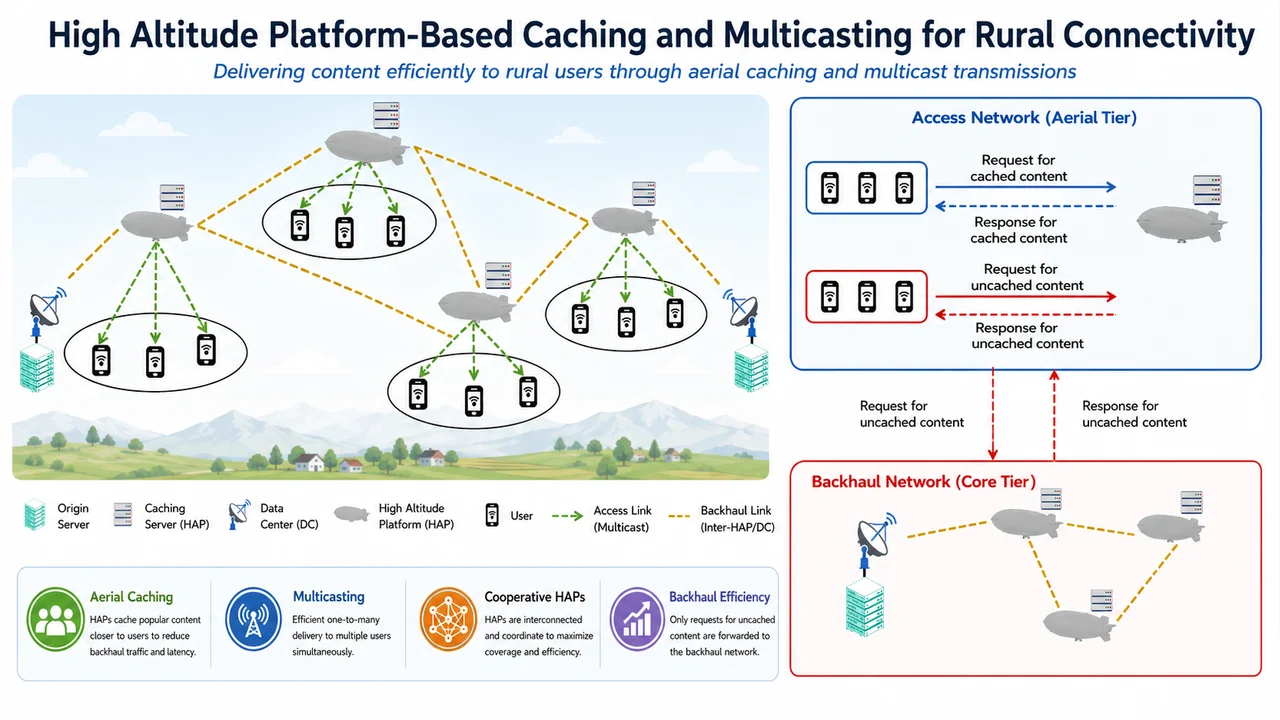
Providing reliable communications across sparsely populated regions remains difficult because terrestrial infrastructure can be expensive or impractical to deploy. High-altitude platforms, or HAPs, offer an alternative by carrying communications equipment above large service areas. The researchers examined how a network of these platforms could deliver frequently requested content while reducing the power required by both aerial backhaul and user-access links.
The proposed network gives each HAP a local cache for storing content, radio-frequency antennas for communicating with users on the ground, and free-space optical links for exchanging data with other HAPs and remote data centers. If requested content is already stored on the serving HAP, it can be sent directly to users. Otherwise, the network retrieves it through the optical backhaul.
A key part of the approach is network coding-based multicasting. Conventional unicast delivery may send separate copies of the same information across the network, which consumes scarce backhaul resources. Network coding instead lets intermediate HAPs encode packets and make better use of multiple communication paths when content must reach several destinations. The approach becomes particularly valuable when optical backhaul bandwidth is limited.
“In rural areas, the backhaul network can be one of the main constraints, so repeatedly sending separate copies of content is inefficient,” said Yongqiang Zhang. “Network coding gives us a way to use those shared links more effectively and coordinate content delivery with what each HAP stores locally.”
The researchers then coordinate caching with the communication resources needed to deliver the content. A deep reinforcement learning method determines which content the HAPs should store as user requests change over time, while optimization techniques allocate optical backhaul resources and radio transmission resources. This joint design seeks to minimize the network's long-term power cost while still meeting users' communication requirements.
Simulation results showed that the proposed framework consistently achieved the lowest average power cost among the approaches considered. In higher-demand scenarios, it reduced average power cost by at least 37.7% compared with the tested alternatives. The simulations also showed that network coding becomes especially useful when backhaul bandwidth is constrained.
The findings highlight the importance of designing caching and communications together rather than treating them as separate network functions. A HAP that stores useful content can reduce the amount of information that must cross the backhaul, while network coding can use the remaining backhaul capacity more efficiently. Together, these techniques could help make aerial communication networks more energy-efficient in rural and difficult-to-connect regions. Further evaluation under real network traffic, location-specific atmospheric conditions and practical HAP implementation constraints would help determine how the approach performs outside the simulated environment.
More information can be found in the paper: