
A New Mathematical Framework for Spatial Correlation Modeling in HAPS Communications
About
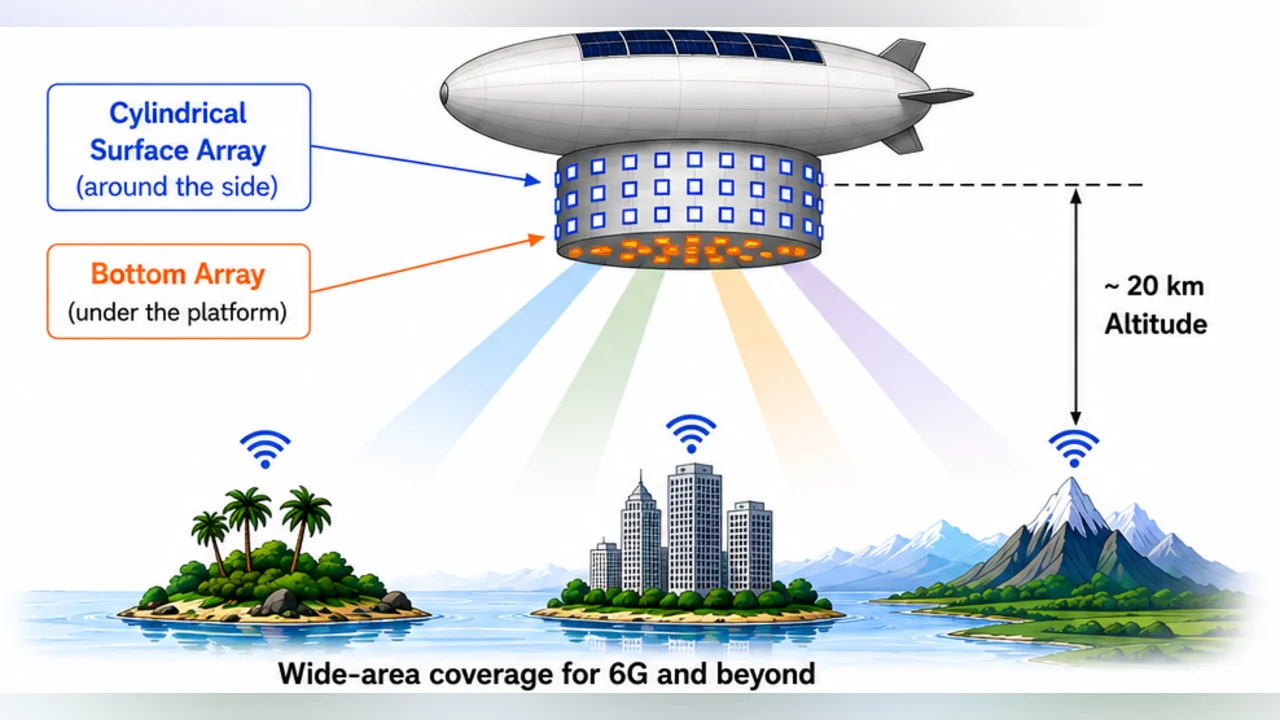
As the world moves toward sixth-generation (6G) wireless communications, researchers are exploring technologies capable of delivering seamless, high-speed connectivity far beyond the reach of conventional terrestrial networks. Among the most promising solutions are high-altitude platform stations (HAPS), aircraft operating in the stratosphere at an altitude of approximately 20 kilometers. Positioned between satellites and ground-based infrastructure, HAPS combine wide-area coverage with relatively low latency and flexible deployment, making them well suited for providing broadband services to remote communities, mountainous regions, oceans, and disaster-affected areas. As non-terrestrial networks become an increasingly important part of future wireless ecosystems.
To support the enormous data demands expected in future 6G networks, HAPS are anticipated to employ massive multiple-input multiple-output (mMIMO) technology. By allowing hundreds of antennas to transmit and receive signals simultaneously, massive MIMO can dramatically improve network capacity, spectral efficiency, and communication reliability. However, realizing these gains depends on accurately understanding how radio signals propagate among large numbers of antenna elements. In practice, neighboring antennas often experience similar propagation conditions, causing their wireless channels to become spatially correlated. This spatial correlation has a significant impact on beamforming performance and overall system capacity, making accurate correlation modeling an essential step in designing future wireless communication systems.
Although spatial correlation has been extensively studied for conventional terrestrial communications, most existing analytical models were developed for linear or planar antenna arrays. These models cannot accurately characterize cylindrical antenna arrays, a three-dimensional architecture that has recently attracted considerable attention for HAPS because of its ability to provide nearly omnidirectional coverage over large geographical areas. Unlike conventional planar arrays, cylindrical arrays distribute antennas around the platform, enabling communication beams to serve users in all directions while significantly expanding the coverage region. Despite these advantages, a rigorous mathematical framework capable of accurately describing the spatial correlation of cylindrical antenna arrays has remained unavailable.
Researchers at King Abdullah University of Science and Technology (KAUST) have now addressed this challenge by developing the first exact analytical framework for three-dimensional spatial correlation modeling of cylindrical massive MIMO antenna arrays. The framework derives closed-form mathematical expressions that accurately characterize the spatial correlation of practical cylindrical HAPS antenna systems while accommodating arbitrary antenna radiation patterns and angular distributions. Because the proposed model is compatible with standardized 3GPP channel models, it can be readily applied to realistic wireless system evaluation and the design of next-generation HAPS communication networks.
To develop the framework, the researchers first modeled the practical antenna configuration used by cylindrical HAPS, including both the antennas distributed around the cylindrical surface and those positioned beneath the platform to provide coverage directly below the aircraft. They then employed spherical harmonic expansion together with Fourier-series representations of the angular power spectra to derive analytical expressions describing the spatial correlation of the antenna elements. By combining these results into a unified framework, the researchers established a comprehensive model capable of representing realistic three-dimensional HAPS antenna systems while significantly reducing the need for computationally intensive numerical analysis.
The accuracy of the proposed framework was verified through extensive Monte Carlo simulations performed under standardized wireless channel conditions. Across a wide range of antenna configurations and angular distributions, the analytical predictions closely matched the simulation results, demonstrating the robustness and accuracy of the proposed model. These results show that the framework enables reliable performance evaluation while substantially reducing the computational effort required by repeated large-scale simulations.
Beyond its theoretical contribution, the research provides a practical tool for the development of future HAPS communication systems. Accurate spatial correlation models allow engineers to optimize antenna deployment, evaluate beamforming algorithms, and predict system performance before deployment in real-world environments. As HAPS are expected to play an increasingly important role in integrated terrestrial, aerial, and satellite networks, such analytical tools will help accelerate the development of efficient and reliable 6G communication technologies.
Looking ahead, the proposed framework also provides a foundation for investigating more advanced three-dimensional antenna architectures, including hemispherical and other non-planar array designs. By addressing a long-standing challenge in wireless channel modeling, the KAUST team's work offers new theoretical insights that will support future research on aerial communication systems and contribute to the realization of ubiquitous global connectivity.
More information can be found in the paper:
Related People


Abla Kammoun
- Senior Research Scientist, Electrical and Computer Engineering

Mohamed-Slim Alouini
- Al-Khawarzmi Distinguished Professor, Electrical and Computer Engineering