KAUST researchers explore HAPS and gateway networks for remote IoT connectivity
About
Connecting large numbers of sensors and wireless devices across deserts, forests, agricultural regions and other areas where fiber infrastructure is difficult or costly to deploy presents a challenge for future Internet of Things networks.
Research team including Hao Lin and Prof. Mohamed-Slim Alouini from King Abdullah University of Science and Technology (KAUST), and Dr. Mustafa A. Kishk from Maynooth University, has developed a mathematical framework showing how high-altitude platform stations, or HAPS, could work together with ground gateway networks to create large-scale continuous connectivity.
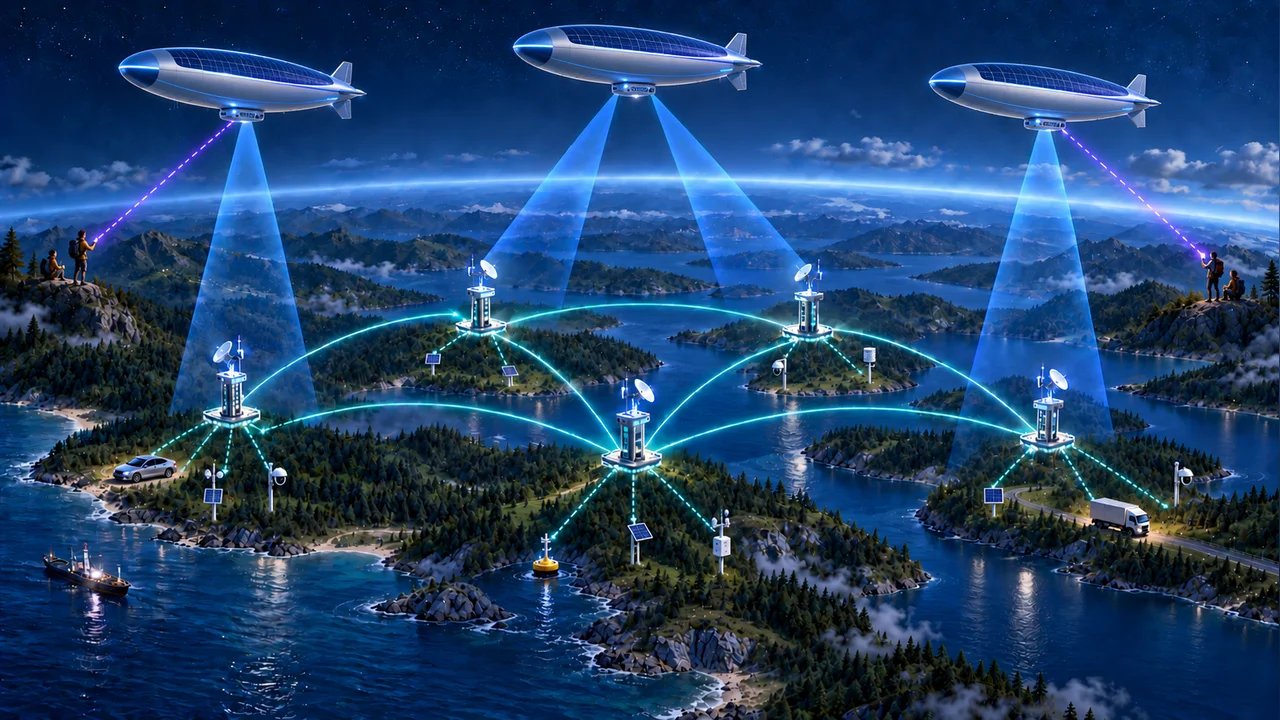
The researchers examined an architecture in which devices first connect to nearby gateways. Those gateways can communicate with one another through wireless links, forming a mesh network, while gateways connected to HAPS provide access to the wider network. This approach could be relevant to applications such as environmental monitoring, smart agriculture and intelligent transportation, where large numbers of distributed devices may need connectivity in places where fixed fiber infrastructure is difficult to deploy.
The study compares three approaches: direct communication between HAPS and devices, communication through gateway networks, and a hybrid architecture combining the two. The researchers use percolation theory to determine when local connectivity clusters can join together to form a large-scale continuous network.
“Ground gateways can act as an intermediate layer between large numbers of devices and HAPS,” said Hao Lin. “Instead of requiring every device to reach a HAPS directly, the gateway network can extend connectivity through local and multi-hop links.”
A key finding is that increasing the availability of gateways can reduce the amount of HAPS infrastructure required to achieve continuous connectivity, while greater HAPS availability can reduce the burden on the gateway layer. This makes gateway deployment more than a simple last-hop solution. In the HAPS-to-gateway-to-device architecture, gateways that are not themselves directly connected to a HAPS may still reach the network through neighboring gateways. In this way, a ground mesh network can extend the effective reach of the aerial infrastructure. In the hybrid architecture, some devices communicate directly with HAPS while others connect through gateways. This can provide additional connectivity opportunities, although practical systems would need to allocate limited spectrum, antenna and energy resources between the two modes.
By identifying the conditions under which HAPS and gateway networks can jointly form continuous service areas, the study offers a way to think about future IoT connectivity as a coordinated air-and-ground network, rather than relying on either layer alone.
More information can be found in the paper: