
KAUST CTL Researchers Win Third Place in Non-terrestrial Networks 2026 International Research Competition
About
Dr. Abdullah Abu Zaid and Prof. Mohamed-Slim Alouini from the CTL research group at KAUST, together with Dr. Baha Eddine Youcef Belmekki from Heriot-Watt University, won third place in the Non-Terrestrial Networks (NTN) 2026 International Research Competition. The competition is organized by Saudi Arabia's Communications, Space and Technology Commission (CST) in partnership with IEEE. The winners were announced at the Global Space Connectivity and Sustainability Events 2026, co-organized by CST and the International Telecommunication Union (ITU) in Riyadh from 12 to 14 October 2026.
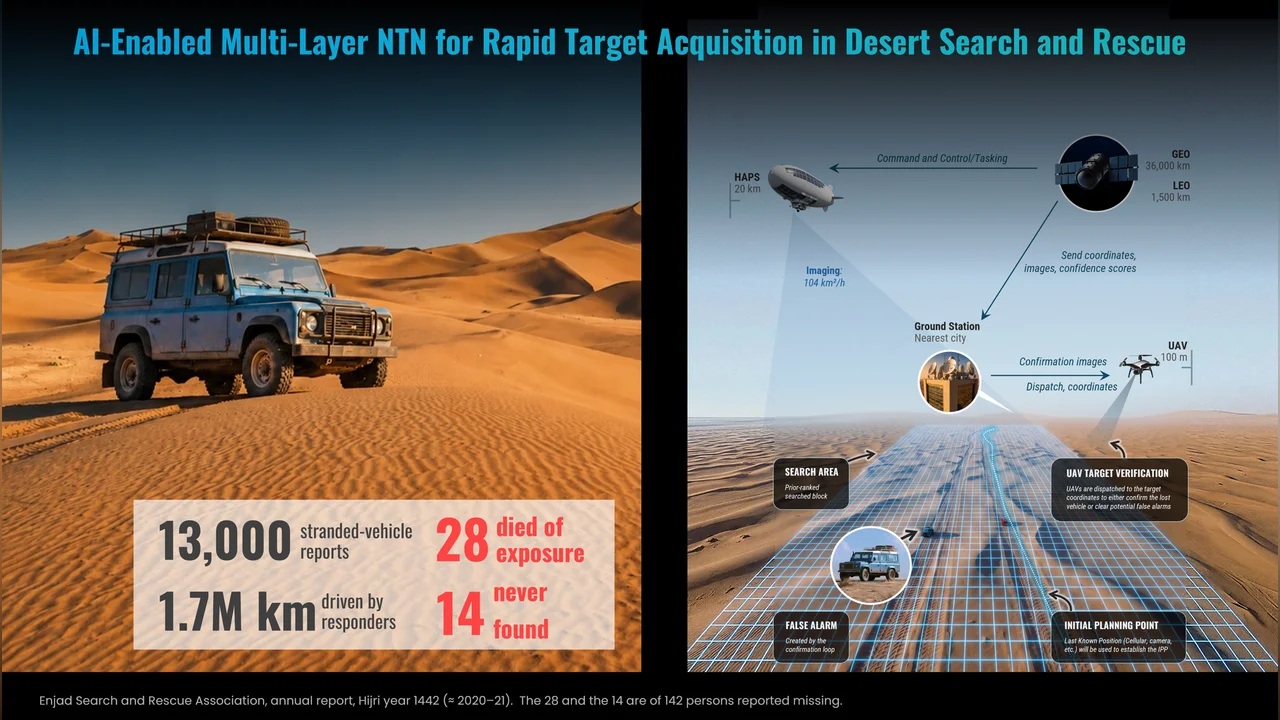
Their paper, titled "AI-Enabled Multi-Layer NTN for Rapid Target Acquisition in Desert Search and Rescue," shows how high-altitude platforms, drones and satellite links can work together to find vehicles stranded in the Kingdom's vast deserts. The recognition follows the same team's best paper award in the Global Advanced Air Mobility (AAM) Academic Paper Competition, hosted by the International Civil Aviation Organization (ICAO) in 2024.
A Rigorous Selection Process
The competition, now in its third edition, is open to researchers, graduate students and recent PhD graduates. This year, it received 81 submissions from universities around the world. In the first round, 40 committee members reviewed the papers, and the top ten were shortlisted for the final.
Two weeks before the Riyadh event, the ten finalists presented their papers in a closed session. Each gave a seven-minute talk followed by three minutes of questions from a panel drawn from academia, the NTN industry and regulators. Entries were scored on four criteria: innovation and originality, sustainability and connectivity impact, practicality and business added value, and presentation and discussion.
The winners were announced at the event itself, with prizes of US$15,000, US$10,000 and US$5,000 for first, second and third place.
The Winning Paper: Finding Silent Targets from the Stratosphere
A vehicle stranded deep in a desert such as the Rub' al-Khali (Empty Quarter) is a silent target. It carries no radio beacon, situated outside of network coverage and cannot call for help. Rescuers must race against time across a vast search area.
The paper proposes a tiered architecture to meet this challenge. High-altitude platform stations (HAPS) in the stratosphere scan wide areas with optical cameras and detect vehicles. Unmanned aerial vehicles (UAVs) are then dispatched to confirm each candidate at close range, while non-terrestrial links connect the platforms to rescue coordinators.
The paper's central finding is that the bottleneck is not sensing but how imagery reaches decision-makers. The authors combined a computer-vision feasibility study with simulations of complete search missions. They found that processing imagery onboard the HAPS, and sending only candidate detections, enables even a modest satellite link to support a wide-area search.
Non-Terrestrial Networks as a Lifeline
Search and rescue in remote areas is, at its core, a connectivity problem: the places where people most need help are often those that terrestrial networks do not reach. This award highlights the role of NTNs not only as a broadband technology but as an enabler of life-saving services in never-connected regions. By sending only what matters over scarce satellite capacity, the architecture also makes efficient use of shared spectrum, relating directly to the competition's emphasis on sustainability.
The work aligns with the mission of the KAUST UNESCO Chair on Education to Connect the Unconnected, which promotes connectivity in hard-to-reach areas and extreme environments. Within this framework, the CTL group is advancing HAPS and broader NTN research for remote, maritime and disaster-affected regions.
Related People

Baha Eddine Youcef Belmekki
- Postdoctoral Research Fellow, Electrical and Computer Engineering
Mohamed-Slim Alouini
- Al-Khawarzmi Distinguished Professor, Electrical and Computer Engineering