
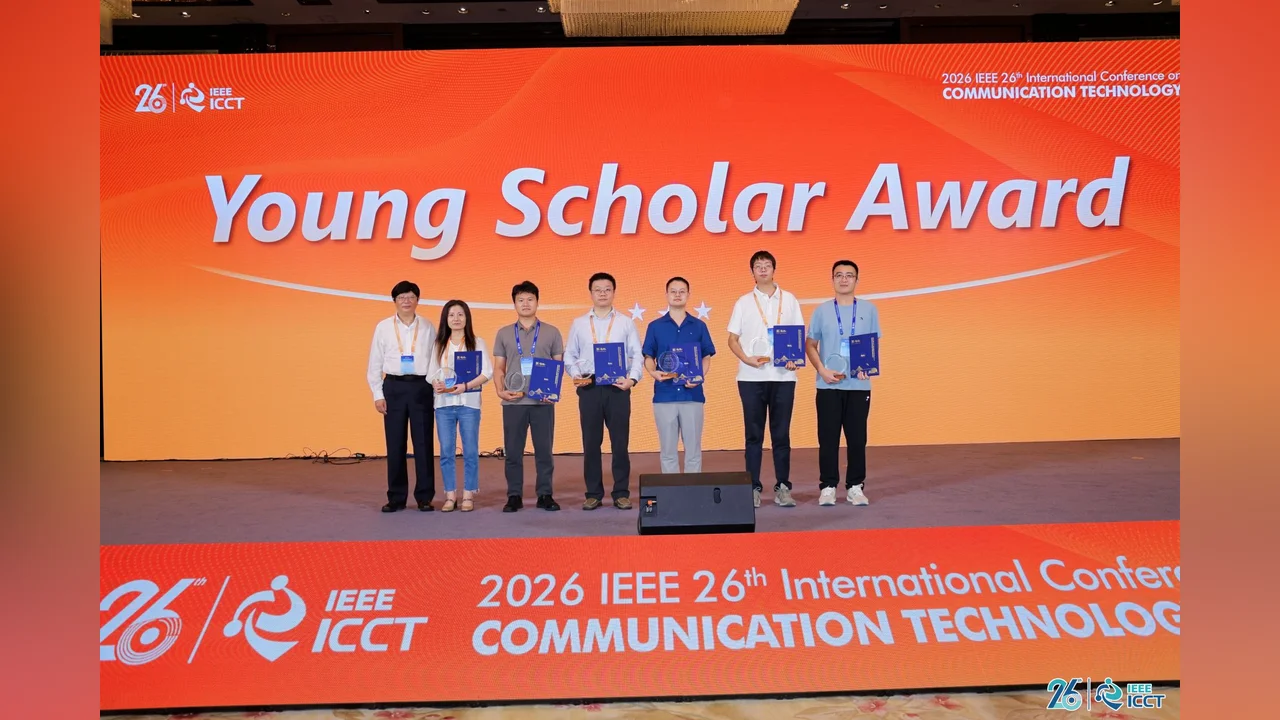
KAUST CTL’s Postdoctoral Fellow Haoxiang Luo receives the 2026 IEEE ICCT Young Scholar Award
The CTL postdoctoral fellow brings together wireless communications, blockchain, and artificial intelligence to advance trustworthy and sustainable networks.
About
Haoxiang Luo (the third person on the right side of the figure), a Postdoctoral Research Fellow in the Communication Theory Lab (CTL) at King Abdullah University of Science and Technology (KAUST), has received the 2026 IEEE ICCT Young Scholar Award.
The recognition comes from the 2026 IEEE 26th International Conference on Communication Technology (ICCT), held in Zhuhai, China, from October 16–18. Established in 1986 by the IEEE Beijing Section and the IEEE Communications Society (IEEE ComSoc), ICCT has built on 25 previous editions to become one of the highest-level academic events in the field of communication technology in China. The Young Scholar Award recognizes young researchers’ research potential, capacity for innovation, and prospects for continued academic development.
Luo explored as part of his PhD how communication and computing networks can become more intelligent while remaining reliable, secure, and energy-efficient. His research spans wireless blockchain networks, trustworthy collaboration among AI agents, and integrated networks connecting space, airborne and ground infrastructure.
These areas share a common challenge: distributed devices must exchange information, coordinate decisions, and share resources despite unreliable connections and limited energy. As AI takes on a greater role in network operation, ensuring that these interactions can be trusted becomes increasingly important.
One strand of Luo’s research examines how blockchain consensus, the process through which distributed participants agree on shared records, can operate efficiently over wireless links. His research also extends to networks of AI agents powered by large language models. Such agents can divide complex tasks, exchange information, and make decisions together, but their collaboration introduces challenges involving inconsistent outputs, unreliable participants, and limited computing resources.
At KAUST, his research further explores the integration of communication and computing across space, air and ground. This includes studying how high-altitude platforms (HAPS) can support AI processing and network services while accounting for energy availability, communication conditions, and task requirements. The aim is to make useful computing services available beyond conventional terrestrial infrastructure without overlooking the physical constraints of airborne platforms. His work addresses a growing need in next-generation non-terrestrial networks: enabling distributed intelligence to operate with dependable coordination and responsible use of communication, computing, and energy resources.
Related People
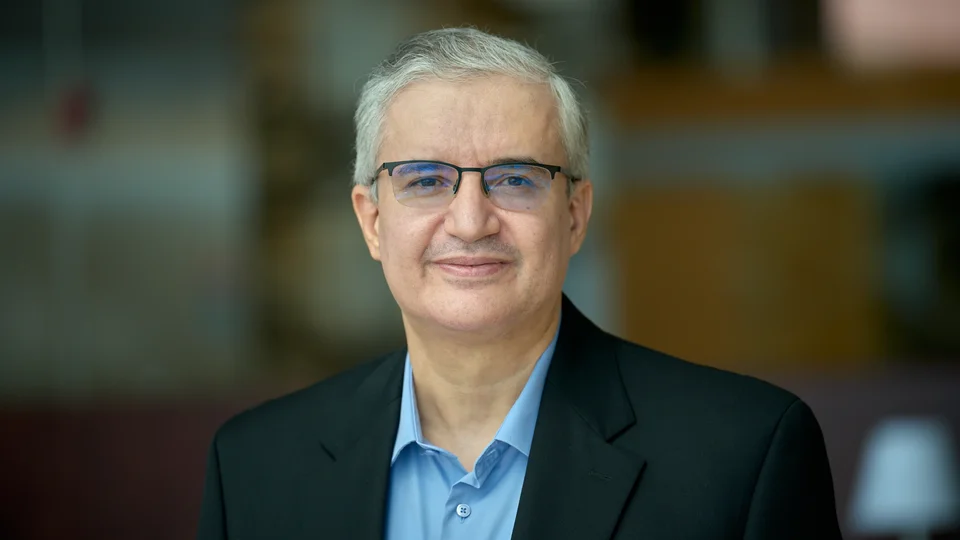
Mohamed-Slim Alouini
- Al-Khawarzmi Distinguished Professor, Electrical and Computer Engineering