
KAUST CTL Graduate Receives Third Place in the 2026 IEEE IoT Technical Community PhD Thesis Competition
About
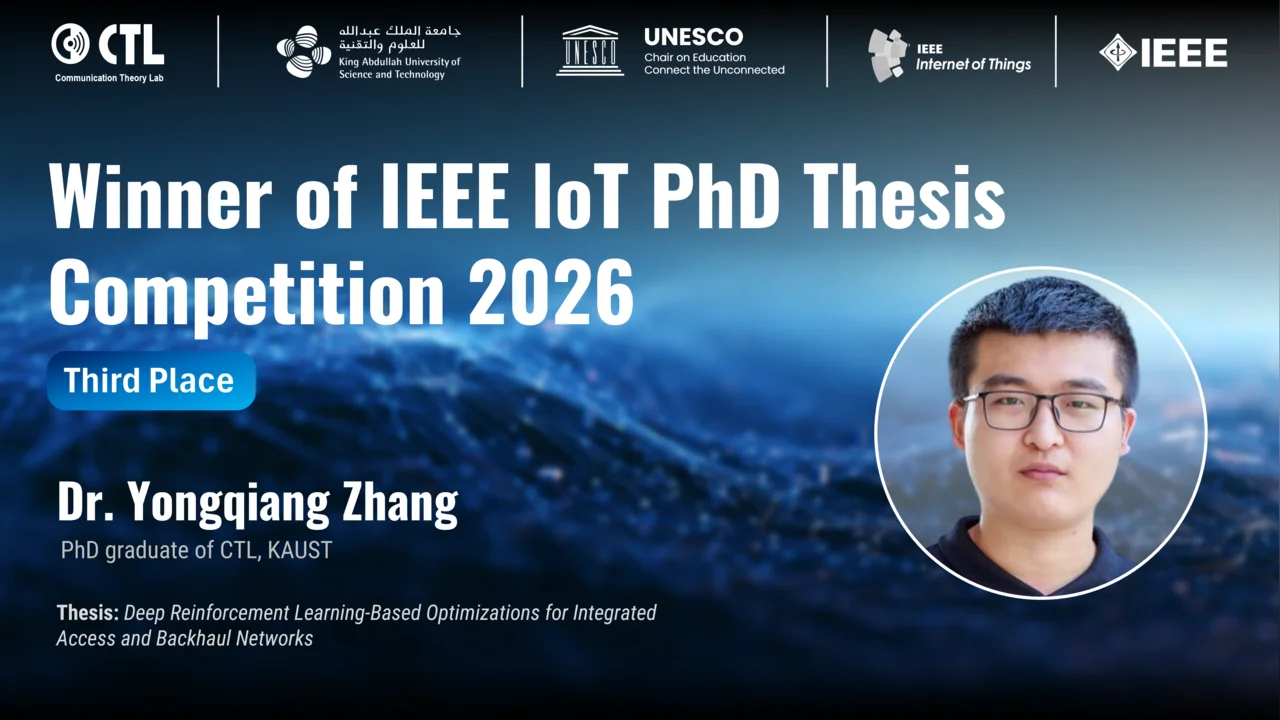
Dr. Yongqiang Zhang, a PhD graduate of the Communication Theory Lab (CTL) at KAUST, has received third place in the 2026 IEEE Internet of Things Technical Community (IoT TC) PhD Thesis Competition. The award was presented at the 12th IEEE World Forum on Internet of Things (WF-IoT 2026), held in Abu Dhabi, UAE, from 26 to 29 October 2026, for his PhD dissertation, “Deep Reinforcement Learning-Based Optimizations for Integrated Access and Backhaul Networks,” completed under the co-supervision of Prof. Mohamed-Slim Alouini at KAUST and Prof. Mustafa A. Kishk of Maynooth University (formerly Post-Doc Fellow at KAUST).
The Award and Selection Process
Organized by the Educational Activities Committee of the IEEE IoT Technical Community, the competition recognizes outstanding doctoral research in the IoT domain. This edition was open to IEEE and IoT TC members who were awarded their PhD between January 2024 and December 2025. Each candidate submitted a nomination statement, a ten-minute video presentation, a supervisor’s endorsement letter and the full thesis, which three expert reviewers evaluated on problem definition, methodology, significance, originality, impact and presentation quality.
The Winning PhD Dissertation
Integrated Access and Backhaul (IAB) networks are attractive wherever fiber is costly or unavailable, but sharing wireless resources between access and backhaul creates complex optimization problems. The thesis addresses them across terrestrial, drone, high-altitude platform (HAP) and satellite networks with Deep Reinforcement Learning (DRL) designs that go beyond the conventional discounted cumulative-reward formulation. These include maximum-reward DRL for network deployment and average-reward DRL for long-term performance, as well as hybrid frameworks that integrate DRL with numerical optimization, in line with the integration of machine learning and operations research. Its key IoT contribution, published in IEEE Transactions on Wireless Communications, is freshness-aware energy efficiency (FAEE), a metric he introduced to measure the information freshness gained per unit of energy consumed, optimized with average-reward DRL. His PhD work also developed tool-augmented AI agents, in which small language models equipped with domain-specific tools autonomously plan and configure HAP networks.
In line with the KAUST UNESCO Chair on Education to Connect the Unconnected, held by Prof. Mohamed-Slim Alouini, much of the thesis targets communities that terrestrial networks do not reach. It shows how HAPs can serve rural areas with both IoT sensing and services such as tele-education, eHealth and broadband. It also shows how tethered drones and aerial IAB networks can extend coverage to underserved areas and support emergency communications, and how satellite and HAP caching can bring content closer to remote users.
Future Work and Scope
Dr. Yongqiang Zhang is now a postdoctoral researcher at New York University Abu Dhabi under the supervision of Prof. Qurrat-Ul-Ain Nadeem, focusing on multiple-input multiple-output (MIMO) communications. Looking ahead, he plans to explore machine learning methods for MIMO systems, including generative modeling approaches such as flow matching. The broader scope is 6G systems compliant with industry standards such as 3rd Generation Partnership Project (3GPP), so that learning-based designs can move from research into practical deployment.
Video Presentation Link: https://youtu.be/p52ULJ7BhBw
Full Thesis Link: https://drive.google.com/file/d/1lIkez5XCkNxQUebeinowKu_ieqa_HV71/view
https://repository.kaust.edu.sa/items/049f9e24-ef89-49b2-9416-995386bfcc16
Related People

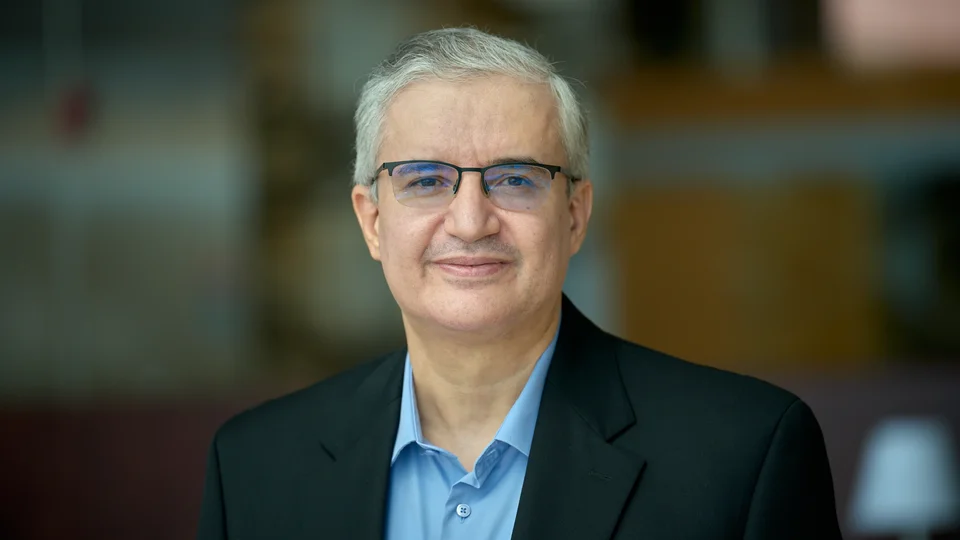
Mohamed-Slim Alouini
- Al-Khawarzmi Distinguished Professor, Electrical and Computer Engineering