
KAUST research identifies suitable wireless solutions for connecting underground sensors to non-terrestrial network platforms
About
Monitoring buried oil and gas pipelines, agricultural soils, and disaster-affected areas increasingly relies on sensors placed below the Earth's surface. These devices can provide continuous information about underground conditions, but transmitting their measurements remains challenging, particularly in remote and hard-to-reach areas. Soil significantly attenuates radio signals, underground infrastructure introduces additional propagation losses, and terrestrial communication networks may be unavailable or unreliable. As the number of sensors increases, interference between simultaneous transmissions further limits the reliability of large-scale underground monitoring.
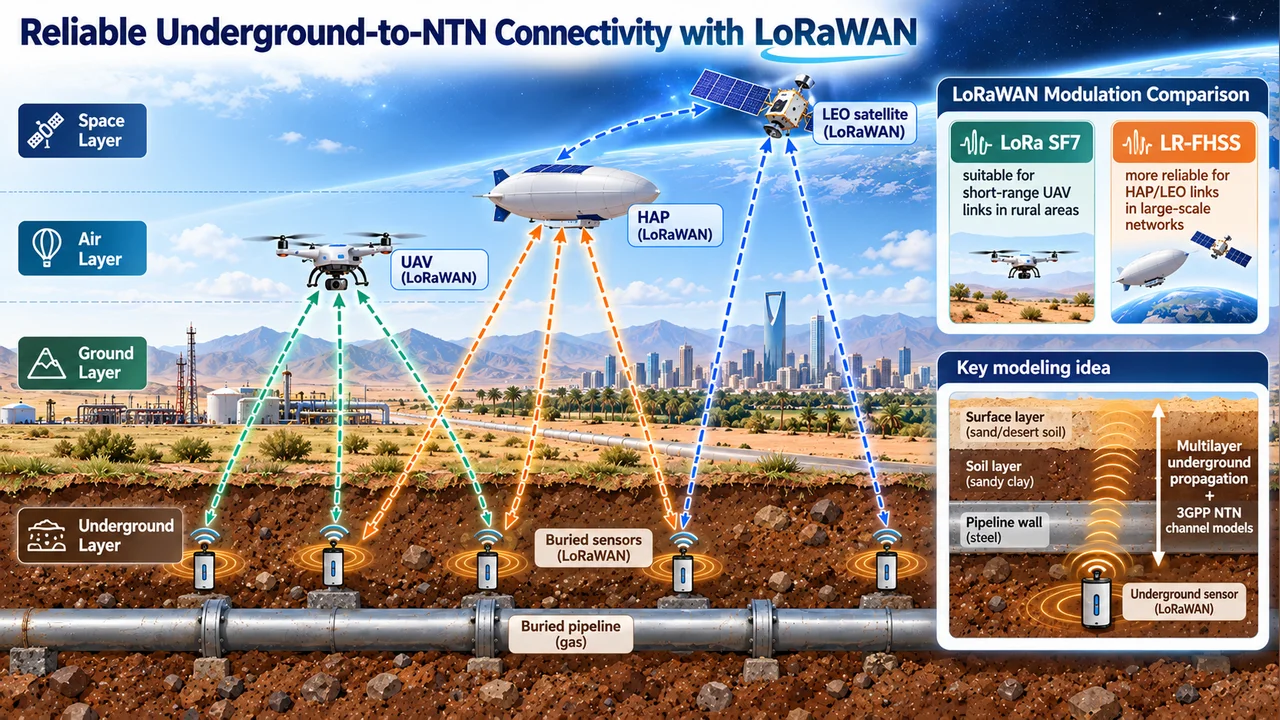
Researchers at King Abdullah University of Science and Technology (KAUST) have investigated how nonterrestrial networks (NTNs) could address these challenges. In a study by Kaiqiang Lin and Professor Mohamed-Slim Alouini, the team explored the feasibility of directly connecting underground sensors to unmanned aerial vehicles (UAVs), high-altitude platforms (HAPs), and low Earth orbit (LEO) satellites using LoRaWAN, a low-power wide-area networking technology. The research aims to identify suitable communication solutions for large-scale underground monitoring in areas where conventional terrestrial infrastructure is limited or unavailable.
UAVs, HAPs, and LEO satellites offer different levels of communication coverage, from localized connectivity to wide-area monitoring. However, substantial underground attenuation, varying communication distances, and different propagation environments make reliable underground-to-NTN connectivity challenging. To address these issues, the researchers investigated two LoRaWAN modulation schemes, i.e., conventional LoRa and long-range frequency-hopping spread spectrum (LR-FHSS). While LoRa offers flexible configurations for balancing communication range and transmission efficiency, LR-FHSS enhances interference resilience through frequency hopping. The study examines which modulation schemes are most suitable for different NTN platforms and underground monitoring environments.
To evaluate their performance, the team developed a Monte Carlo simulation framework combining a multilayer underground propagation model with 3GPP channel models for UAV, HAP, and LEO satellite communications. Using an underground pipeline monitoring scenario in Saudi Arabia, the researchers simulated 50,000 buried devices and investigated how deployment environments, network size, burial depth, and soil moisture affect communication reliability. The results show that LoRa SF7 is well suited for short-range UAV communication in rural environments, while LR-FHSS generally provides more reliable connectivity for HAPs and LEO satellites in large-scale underground networks. Communication reliability also deteriorates with increasing burial depth and soil moisture, while urban propagation environments introduce additional challenges. These findings demonstrate that the choice of NTN platform and LoRaWAN modulation scheme should be tailored to specific deployment conditions.
The study provides a framework for evaluating underground-to-NTN connectivity and offers guidance for extending large-scale underground monitoring beyond conventional terrestrial coverage. The findings could support future applications in smart agriculture, underground pipeline monitoring, and post-disaster response, although further experimental validation is required to assess practical deployment performance.
More information can be found in the paper:
K. Lin and M. -S. Alouini, “Connectivity Analysis of LoRaWAN-Based Nonterrestrial Networks for Subterranean mMTC,” IEEE Internet of Things Journal, vol. 12, no. 23, pp. 50604-50616, 2025.
Related People


Mohamed-Slim Alouini
- Al-Khawarzmi Distinguished Professor, Electrical and Computer Engineering