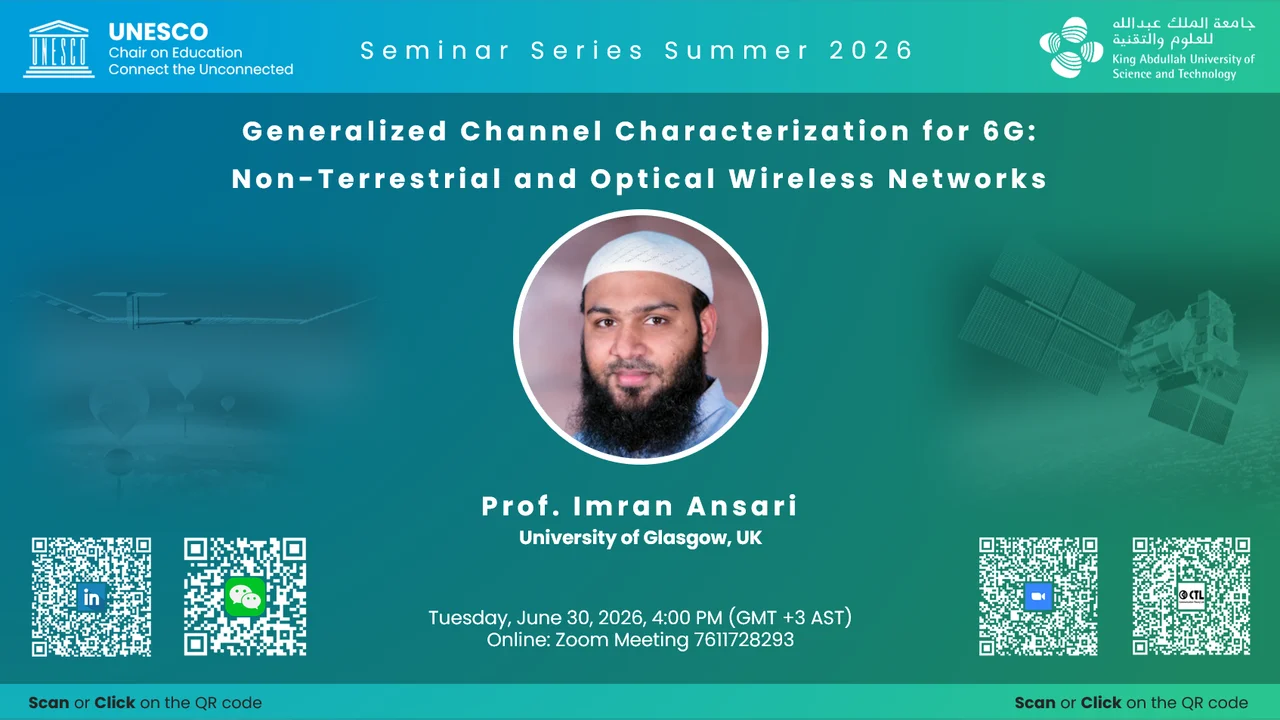
Generalized Channel Characterization for 6G: Non-Terrestrial and Optical Wireless Networks
Overview
Future Beyond-5G and 6G networks will require seamless integration of terrestrial, aerial, satellite, optical, and underwater communication infrastructures to enable ubiquitous connectivity, ultra-high reliability, massive scalability, and intelligent network operation. This seminar presents recent advances in the performance analysis and design of next-generation wireless communication systems spanning free-space optical (FSO), underwater optical and acoustic communications, mixed radio-frequency (RF)-optical networks, and autonomous aerial reconfigurable intelligent surface (RIS)-enabled communications. The talk introduces novel analytical frameworks that overcome longstanding mathematical challenges in the performance evaluation of complex wireless systems, enabling accurate characterization of outage probability, error rates, capacity, coverage, and reliability under diverse propagation conditions. Particular attention is given to multi-hop amplify-and-forward and decode-and-forward relaying architectures, mixed RF-underwater optical systems, hybrid underwater acoustic/optical networks, and swarm-enabled aerial RIS platforms operating in challenging fading and turbulence environments. Furthermore, the seminar highlights the role of intelligent surfaces, autonomous aerial vehicles, optical wireless technologies, and integrated multi-domain communication architectures as key enablers of 6G. The presented results provide valuable insights into designing resilient, energy-efficient, and high-capacity communication networks capable of supporting future applications such as autonomous systems, smart oceans, remote sensing, connected robotics, and global connectivity. Collectively, these contributions advance the vision of a fully integrated 6G ecosystem where terrestrial, aerial, space, and underwater networks operate synergistically to deliver pervasive and intelligent communications.
Presenters
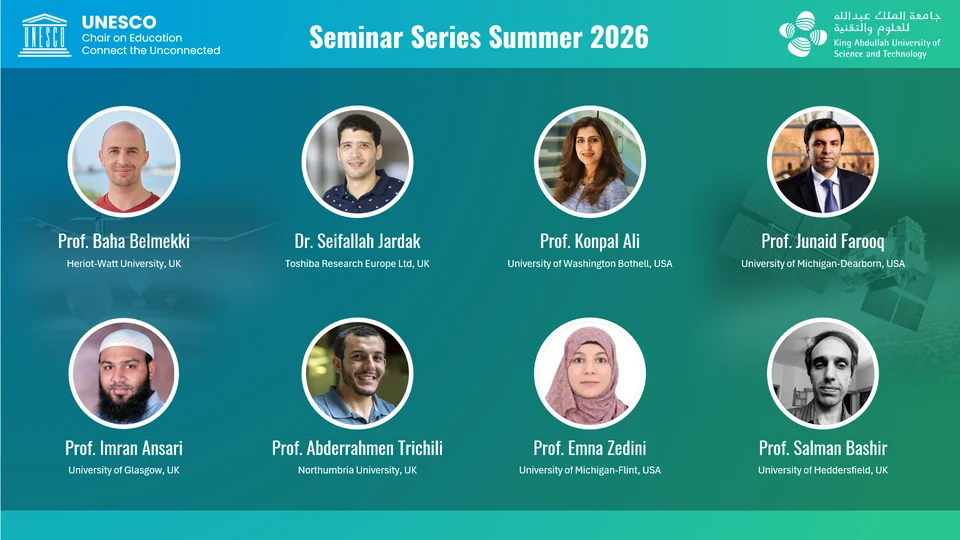
Imran Ansari, University of Glasgow, UK
Brief Biography
Imran Shafique Ansari (S’ 07-M' 15-SM' 23) received the B.Sc. degree in Computer Engineering from King Fahd University of Petroleum and Minerals (KFUPM) in 2009 (with First Honors) and M.Sc. and PhD degrees from King Abdullah University of Science and Technology (KAUST) in 2010 and 2015, respectively. Currently, since August 2018, he is an Assistant Professor with University of Glasgow, Glasgow, UK.
He has been affiliated with IEEE since 2007 and has served in various capacities. He is serving on IEEE European Public Policy Committee ICT WG 2025-2026 and IEEE LEO SatS Future Directions since 2022. He has served on the IEEE EPPC 2023-2024, IEEE Nominations and Appointments (N&A) Committee 2020-2021, and IEEE Communication Society Young Professionals (ComSoc YP) Board 2016-2021. He is part of the IEEE 5G Tech Focus Publications Editorial Board since Feb. 2017. He is an active reviewer for EPSRC research grants, various IEEE Transactions and various other journals. He has served as a TPC for various IEEE conferences and chaired IEEE ICC Wireless Communications (WC) Symposia 2024.
Dr. Ansari has authored/co-authored 150+ journal and conference publications. He has co-organized the GRASNET'2016, 2017, 2018 workshops in conjunction with IEEE WCNC'2016, 2017 and IEEE Globecom 2018. His current research interests include free-space optics (FSO), satellite communications, underwater communications, physical layer secrecy issues, and reconfigurable intelligent surfaces / intelligent reflective surfaces (RIS / IRS), among others.