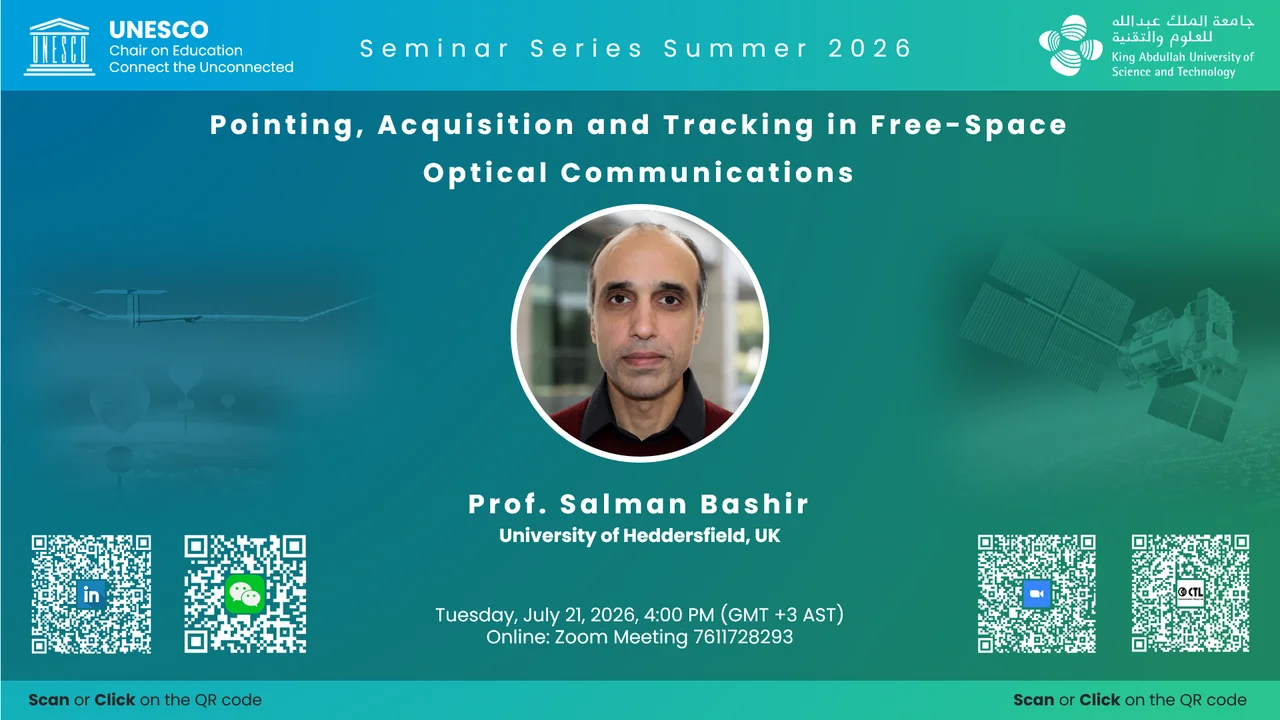
Pointing, Acquisition and Tracking in Free-Space Optical Communications
Overview
Pointing, acquisition, and tracking (PAT) pose significant challenges in free-space optical (FSO) communications. This talk will cover the fundamentals of beam acquisition and tracking for an FSO receiver. For the acquisition phase, we will discuss spiral scanning and adaptive scanning techniques, along with a comparative assessment of their performance. Following acquisition, we will examine beam tracking, focusing on how an array of small detectors is used to estimate the angle-of-arrival of the laser beam. Finally, we will evaluate tracking system performance using Cramér–Rao lower bounds.
Presenters
Salman Bashir, University of Heddersfield, UK
Brief Biography
Muhammad Salman Bashir (Senior Member, IEEE) received the M.S. and Ph.D. degrees in electrical and computer engineering from Purdue University, West Lafayette, Indiana, USA, in 2014 and 2017, respectively. From 2019 to 2023, he was a Postdoctoral Fellow with the Communication Theory Lab, King Abdullah University of Science and Technology, Thuwal, Saudi Arabia. From 2017 to 2018, he served as an Assistant Professor with the Department of Electrical Engineering, National University of Computer and Emerging Sciences, Lahore, Pakistan. He is currently a Senior Lecturer with the School of Computing and Engineering, University of Huddersfield, Huddersfield, U.K. His research interests include the application of signal processing and information-theoretic techniques to free-space optics and laser-powering systems in non-terrestrial communication networks. Dr. Bashir was the recipient of the State Department’s Fulbright Science and Technology Award from Purdue University. He is currently an Associate Editor for IEEE COMMUNICATION LETTERS.