
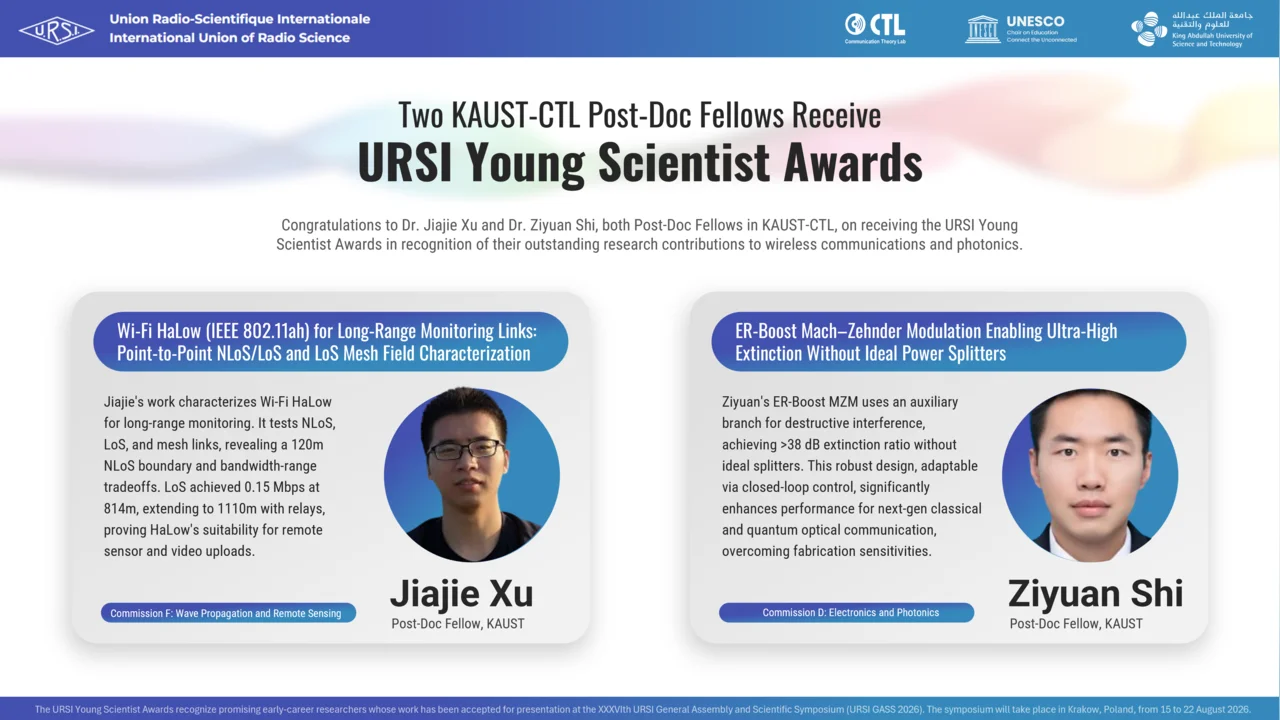
Two KAUST CTL Postdoctoral Fellows receive URSI Young Scientist Awards
Congratulations to Dr. Jiajie Xu and Dr. Ziyuan Shi, both postdoctoral fellows in CTL, on receiving the URSI Young Scientist Awards in recognition of their outstanding research contributions to wireless communications and photonics.
About
The URSI Young Scientist Awards recognize promising early-career researchers whose work has been accepted for presentation at the XXXVIth URSI General Assembly and Scientific Symposium (URSI GASS 2026). The symposium will take place in Krakow, Poland, from 15 to 22 August 2026. Awardees are expected to participate fully in the scientific activities of URSI GASS and will receive support including registration, board and lodging. Their works were accepted for presentation under Commission F: Wave Propagation and Remote Sensing and Commission D: Electronics and Photonics, respectively.
Dr. Jiajie Xu: Wi-Fi HaLow (IEEE 802.11ah) for Long-Range Monitoring Links: Point-to-Point NLoS/LoS and LoS Mesh Field Characterization
(accepted for presentation under Commission F: Wave Propagation and Remote Sensing)
Monitoring deployments often require reliable long-range wireless links to intermittently upload sensor logs and short video snapshots. Wi-Fi HaLow (IEEE 802.11ah) is a promising candidate due to sub-1 GHz propagation and bandwidth-flexible PHY modes. Jiajie’s work reports a field characterization organized around three deployment-driven regimes: (i) point-to-point Non-Line-of-Sight (NLoS) links; (ii) point-to-point Line-of-Sight (LoS) links over several-hundred-meter distances; and (iii) LoS mesh networking with fixed relay nodes for range extension. Using commodity HaLow dongle-class nodes in all regimes, the study reports application-layer goodput and monitoring-centric update latency based on transferring a representative “heavy” object (a ∼30 s video file). The measurements reveal (a) a clear bandwidth–range tradeoff and an NLoS coverage boundary around ∼120 m, (b) gradual throughput decay under LoS up to 814 m in single-hop with 0.15 Mbps at the farthest point, and (c) kilometer-class extension under LoS when fixed relays are introduced, reaching 901 m (two fixed relays) and 1110 m (three fixed relays).
Jiajie Xu is a Postdoctoral Fellow at the Computer Electrical and Mathematical Sciences and Engineering Division (CEMSE), King Abdullah University of Science and Technology (KAUST), working with Professor Mohamed-Slim Alouini in the Communication Theory Lab (CTL). He received his Master's Degree in Control Theory and Control Engineering from Yanshan University, China, in 2019 and received his Ph.D. degree in Electrical and Computer Engineering from KAUST, KSA, in 2023. Jiajie Xu is interested in signal processing, acoustic and optical communication, target localization and detection, integrated sensing and communication, and underwater sensor networks, especially underwater wireless sensor networks.
Dr. Ziyuan Shi: ER-Boost Mach–Zehnder Modulation Enabling Ultra-High Extinction Without Ideal Power Splitter
(accepted for presentation under Commission D: Electronics and Photonics)
Ziyuan Shi’s work proposes and experimentally demonstrates a novel ER-Boost Mach–Zehnder Modulator (MZM) designed to achieve ultra-high extinction ratio (ER) without relying on ideal 50:50 optical power splitters. The key idea is to introduce an auxiliary extinction-enhancement branch that generates a controllable optical field. By carefully adjusting its amplitude and phase, this auxiliary signal destructively interferes with the residual optical leakage from the main modulation branch, significantly improving the extinction ratio. Unlike conventional MZMs, which are highly sensitive to fabrication imperfections and thermal drift, the proposed architecture is more robust because it shifts the burden from precise structural balance to adaptive interference control. A closed-loop bias control system is employed to dynamically optimize three voltages (modulation, enhancement, and phase), ensuring stable operation under practical conditions. Experimental results show that the system achieves an extinction ratio exceeding 38 dB, significantly outperforming traditional designs, especially in photon-counting optical communication systems such as PPM links. Overall, this work provides a practical, fabrication-tolerant, and high-performance modulation solution for next-generation classical and quantum optical communication systems.
Ziyuan Shi received his Ph.D. in Computer Technology and Applications from the University of Chinese Academy of Sciences in 2023 and is currently a Postdoctoral Researcher at King Abdullah University of Science and Technology (KAUST), working in the Communication Theory Lab (CTL). His research focuses on advanced optical communication systems, quantum communication, and digital signal processing (DSP), with particular emphasis on single-photon communication and high-sensitivity optical links. He has also contributed to large-scale research projects, including deep-space optical communication systems and UAV-based laser communication platforms, where he led system design, algorithm development, and experimental validation. In addition, he has extensive experience in optical system design, FPGA development, and hardware-software co-design, enabling end-to-end implementation of high-speed communication systems.
Related Highlights
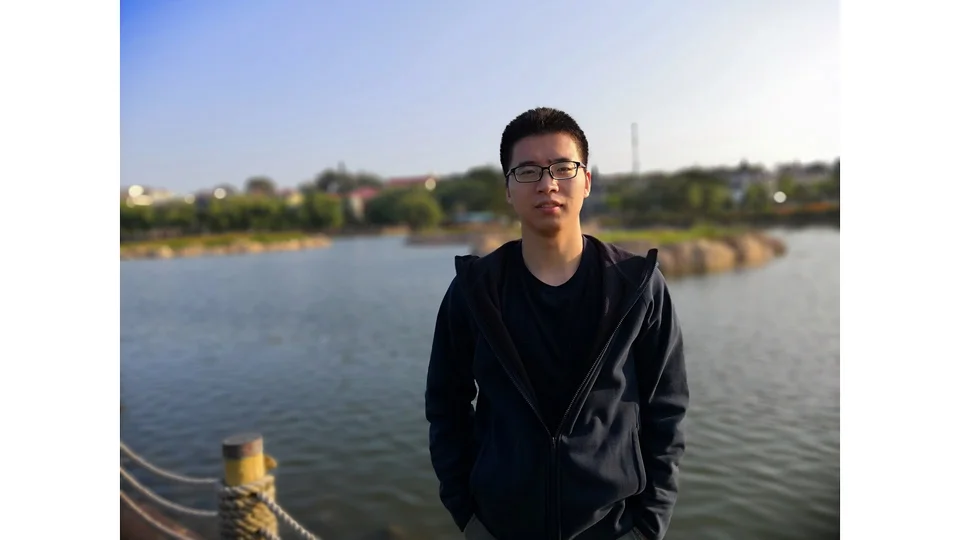

Ziyuan Shi
- Postdoctoral Research Fellow, Electrical and Computer Engineering
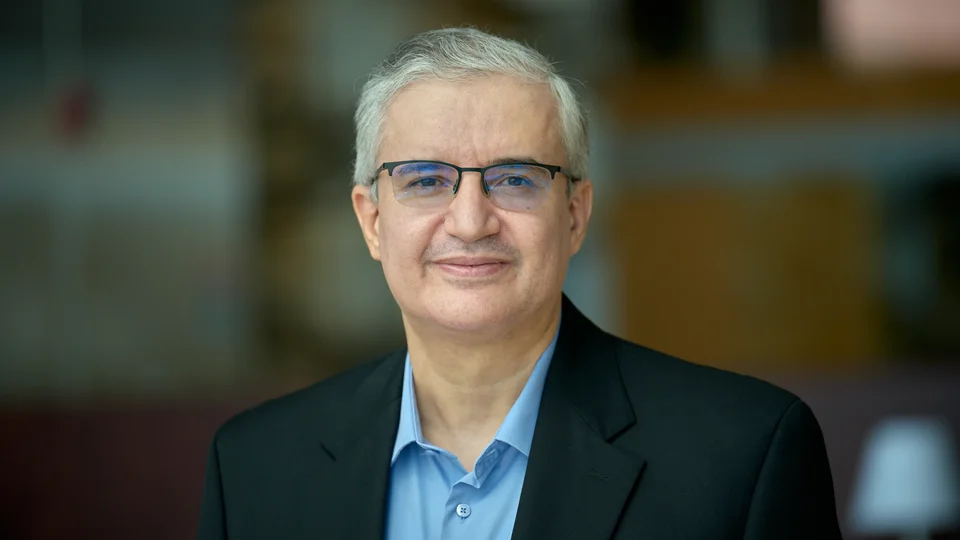
Mohamed-Slim Alouini
- Al-Khawarzmi Distinguished Professor, Electrical and Computer Engineering