Skip to main content
Communication Theory Lab
Communication Theory Lab
Home
News
Events
People
All People
Principal Investigator
Research Scientists
Postdoctoral Fellows
Students
Visiting Scholars
Former Members
Former Members from Texas A&M University
Former Members from University of Minnesota
Collaborators
Alumni
Research
Publications
Teaching
Funding
Media
Contact Us
spectral density function
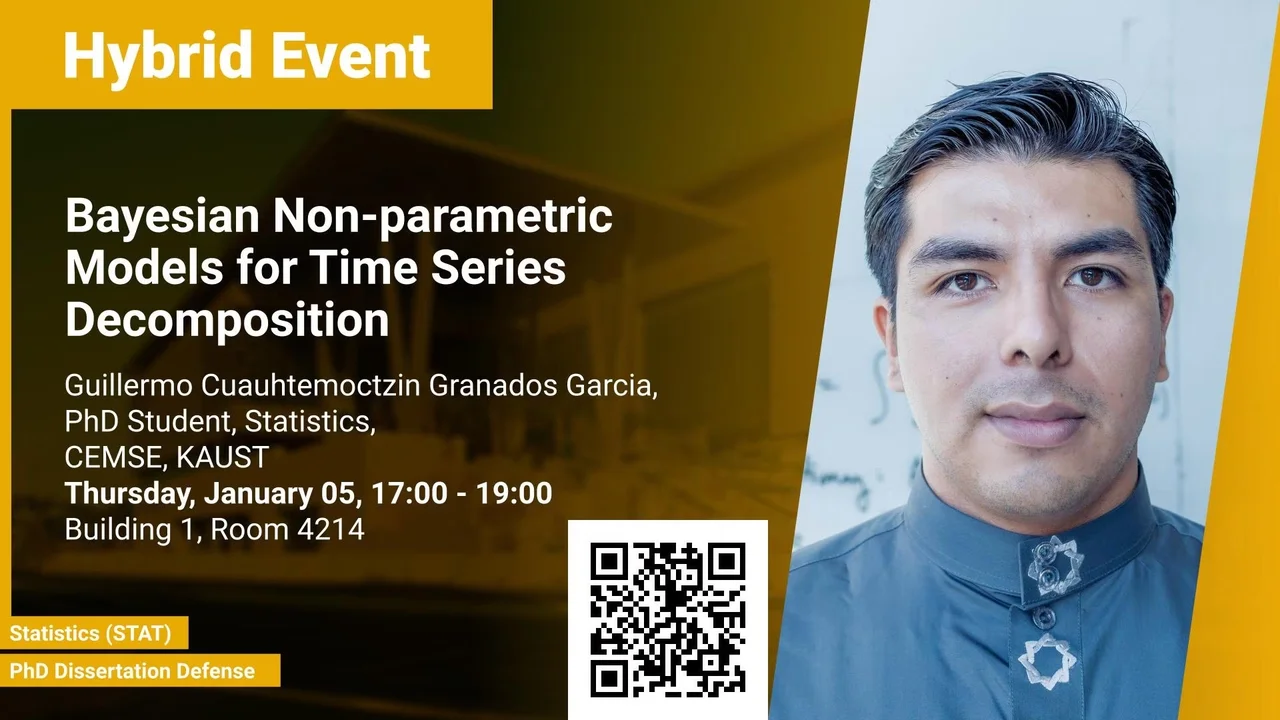
Bayesian Non-parametric Models for Time Series Decomposition
Guillermo C. Granados Garcia, Ph.D. Student, Statistics
Jan 5, 17:00
-
19:00
B1 R4214
spectral density function
The standard approach to analyzing brain electrical activity is to examine the spectral density function (SDF) and identify frequency bands, defined apriori, that have the most substantial relative contributions to the overall variance of the signal. However, a limitation of this approach is that the precise frequency and bandwidth of oscillations are not uniform across cognitive demands. Thus, these bands should not be arbitrarily set in any analysis. To overcome this limitation, we propose three Bayesian Non-parametric models for time series decomposition, which are data-driven approaches that identify (i) the number of prominent spectral peaks, (ii) the frequency peak locations, and (iii) their corresponding bandwidths (or spread of power around the peaks).